
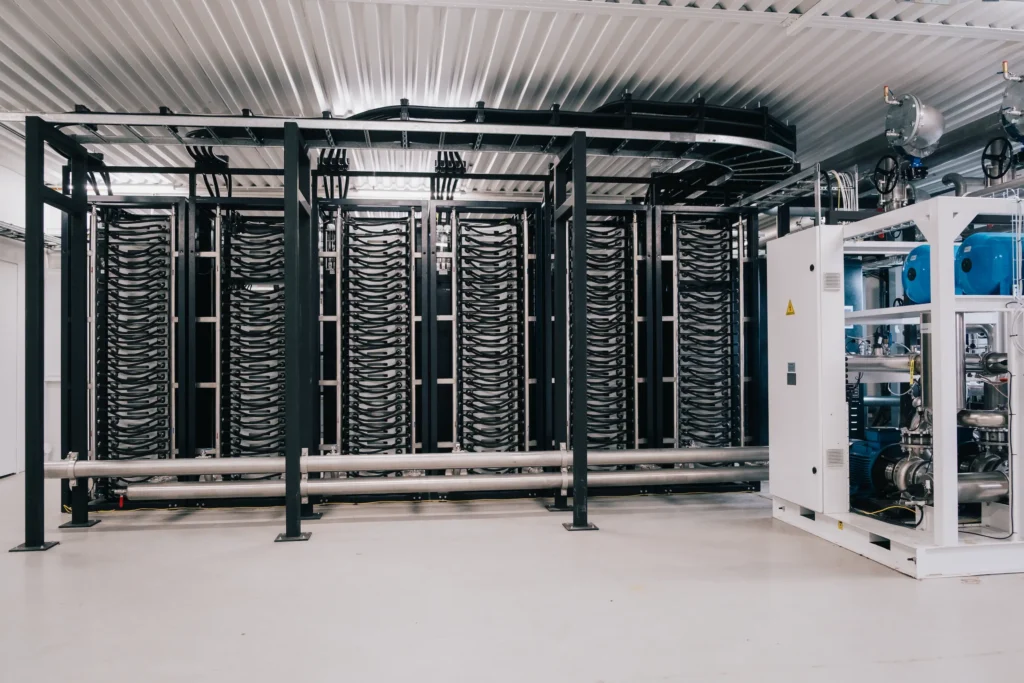
Data centres are often discussed as major energy consumers, and the topic has received increasing attention in recent years. What is less widely known, however, is that a data centre can also form part of the local energy system and contribute, for example, to district heating production. In Finland, many of the challenges often associated with data centres can also be mitigated thanks to the country’s geographical location and operating conditions.
A local data centre that heats homes and uses less water than expected
The integration of data centres into local energy systems is one of the most significant modern innovations supporting both energy self-sufficiency and sustainable development. In Seinäjoki, MinersLoop’s data centre produces heat at approximately 5 megawatts. During the summer, when district heating demand is lower, this can cover nearly half of the city’s district heating needs. During the coldest winter periods, the share is naturally smaller, but the recovered heat is still sufficient to warm hundreds of homes.
“In Finland, solutions like this are becoming increasingly common. Once the heat is recovered, a data centre is no longer only an electricity consumer, but also a heat producer,” says Pete Karjalainen, Chief Operating Officer of MinersLoop.
The cooling process uses water, which absorbs heat from the equipment as it circulates through the system. The warmed water is then transferred to a heat pump, which raises the temperature to the level required by the district heating network. At the same time, the heat pump returns cooled water back into the system for continued equipment cooling. The recovered heat is then transferred into the local district heating network, where it is used to heat homes and commercial buildings.
Flexible mining supports a balanced power grid
Data centres based on Bitcoin mining have one particular advantage: their operation can be adjusted flexibly. Unlike traditional server facilities, where services must remain almost continuously available, mining equipment can be shut down when necessary without interrupting internet-based services.
This means that data centre operations can be balanced according to electricity availability. When electricity supply is abundant, for example during windy periods with high renewable generation, mining operations can continue without concern for grid load. If electricity becomes scarce, the equipment can be shut down quickly without causing operational disruption. As a result, data centre operations do not automatically consume a disproportionate share of available electricity or place excessive pressure on the power grid to the extent that consumer electricity prices would significantly increase.
Why Finland is an ideal location for data centres
Finland offers several geographical, political, and climate-related advantages that directly benefit data centre operations. The cool climate supports efficient equipment cooling, reducing overall energy consumption. In addition, abundant water resources make it possible to use water as part of the cooling process without creating shortages in municipal water supply. At MinersLoop’s facility in Seinäjoki, only a few cubic metres of water circulate within a closed-loop system. The same water is used both for cooling the equipment and for generating thermal energy over a period of several years. Finland also benefits from a low level of geographical risk.
Natural disasters such as major earthquakes or severe hurricanes that threaten buildings are not typical risks in Finland. In addition, the country is widely regarded as one of the safest locations for data centres due to its political stability and highly reliable electricity infrastructure. Power outages are rare, and the Finnish electricity grid is considered highly stable by global standards. The combination of climate efficiency, operational safety, and energy infrastructure makes Finland an increasingly attractive location for modern data centre investments.
Roni Karjalainen
CEO